

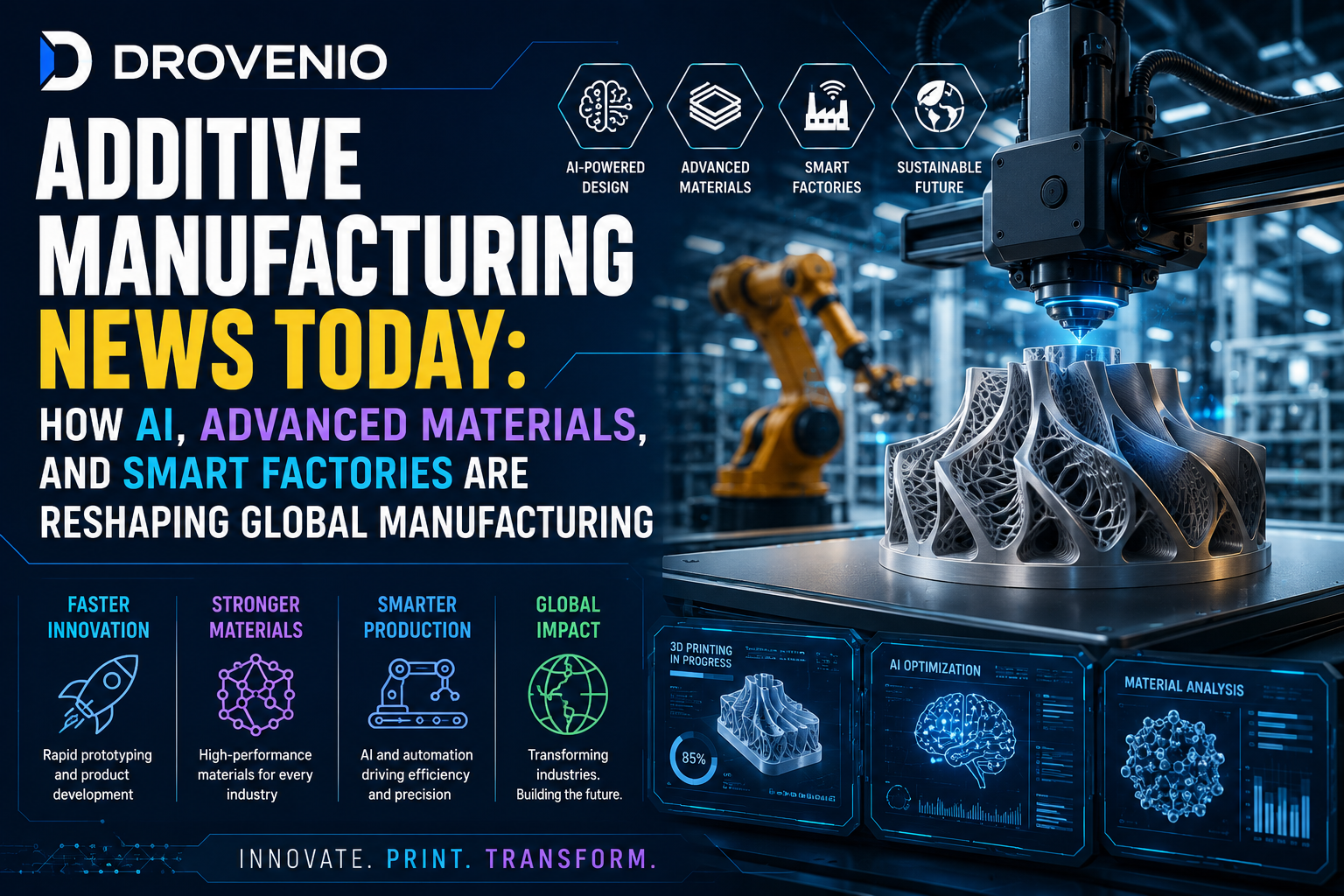
Additive manufacturing is about to undergo the biggest change since the Industrial Revolution. With all the additive manufacturing news today from all sectors, that pace of change is only accelerating.
Where additive once was seen as the go-to solution for prototyping speed, this technology has become a serious production alternative for companies requiring speed, precision, and flexibility.
Aerospace is 3D-printing lighter-weight engine parts for speed; Hospitals are using additive to 3D-print customized medical devices for patient care; Automotive companies are shaving production times using sophisticated 3D printers, and they’re not merely fabricating parts; they’re 3D-printing the future of smart, sustainable manufacturing.
Why Additive Manufacturing Is Becoming an Industry Standard
Additive Manufacturing Makes Manufacturing Cost-Efficient and Rapid. Additive manufacturing has eliminated the high-cost, custom-machined molds, tooling, and long cycle times involved with the traditional methods of making components. Parts are manufactured using designs, moving from concept to completed product extremely quickly,y and the resulting methods provide unique advantages:
- Faster product development
- Lower production costs for custom parts
- Reduced material waste
- Greater design freedom
- Shorter supply chains
- On-demand manufacturing
The promise of such gains is compelling several companies across a range of industries, convincing them to rethink the nature of product design and development.
Artificial Intelligence Is Creating the Next Generation of 3D Printing.
The trend in additive manufacturing headlines recently is the increasing convergence of artificial intelligence and 3D printing at the industrial level.
These AI-powered 3D printers are able to crunch thousands of variables of production parameters in real time.
That allows manufacturers to detect issues as a part is printing, instead of when production is complete. Here’s how AI is helping manufacturers improve their 3D printing processes:
- Predictive machine maintenance
- Automated defect detection
- Print parameter optimization
- Material usage analysis
- Production scheduling
- Quality assurance
These outcomes include improved reliability, enhanced operational costs, and greater product consistency.
Advanced Materials Are Expanding Manufacturing Possibilities
Printing is only part of additive manufacturing, but so is the material that’s being used.
It may seem simple enough, but scientists are continuing to produce lighter, stronger, more durable materials that hold up to industry-specific applications.
Some of today’s hottest materials are:
- High-performance titanium alloys
- Carbon fiber composites
- Heat-resistant engineering polymers
- Stainless steel powders
- Ceramic materials
- Sustainable bio-based filaments
With these technologies at their disposal, manufacturers can create part designs that excel in the most demanding environments, such as within aircraft engines, medical devices, and heavy industrial equipment.
Aerospace Continues to Lead Industrial Innovation
Additive manufacturing is perhaps being adopted faster by the aerospace sector than any other. Shedding 1 kg of weight from an airplane saves on fuel, so it follows that light parts have great value.
Engineers have been able to manufacture components with complicated interior geometries that they never could before with conventional methods.
Existing applications are found in:
- Fuel nozzles
- Turbine components
- Structural brackets
- Satellite parts
- Rocket engine components
In addition to its weight advantages, additive manufacturing eases maintenance as any necessary replacement parts can be fabricated on demand more efficiently.
Healthcare Is Becoming More Personalized
One sector enjoying rapid growth is medical technology. Rather than standardising parts and products, manufacturers in the healthcare sector are already leveraging additive manufacturing to develop products specifically designed for individual patients.
Medical applications that already exist:
- Custom prosthetics
- Dental aligners
- Orthopedic implants
- Surgical planning models
- Hearing devices
Before the operation, surgeons can examine a faithful 3D copy of the human anatomy and gain increased accuracy – shortening operating time and reducing risks to patients.
Automotive Companies Are Reinventing Product Development
Weight efficiency: Engineers and designers face the never-ending demand to produce lighter and yet safer, more fuel-efficient vehicles. The speed at which additive manufacturing can iterate concepts can save weeks compared to the time needed for traditional tooling development.
The flexibility provided by 3D printing can enable:
- Build prototypes within days
- Reduce development costs
- Improve electric vehicle efficiency
- Manufacture low-volume performance parts
- Produce replacement components on demand
With electrification growing, AM could have an increasingly significant role across the entire automotive supply chain.
Smart Factories Are Connecting Every Machine
We are entering an era of ever more connected factories due to the Internet of Industrial Things. Your modern 3D printers continuously produce a stream of production data that could potentially help increase your factory throughput by identifying bottleneck processes.
A connected manufacturing system offers:
- Real-time production monitoring
- Equipment performance analysis
- Remote machine management
- Predictive maintenance alerts
- Automated inventory tracking
Combine it with other technologies, and you have got smart factories that are versatile enough to respond rapidly to any shift in production needs.
Sustainability Is Driving Long-Term Growth
Environmental benefits are probably one of the biggest drivers of the adoption of 3D printing technologies by manufacturing organizations.
As opposed to subtractive manufacturing, additive manufacturing produces less material waste as it requires only the required amount of material.
It also decreases logistics and transportation costs as manufacturers can produce goods on a localized basis.
In the future, they may even explore recycling options for their prints or adopt energy-efficient 3D printing methods to further decrease their environmental impact.
Challenges Still Need to Be Solved
Even with that incredible leap, here’s a look at what we’ve still got to tackle to get us to the point where additives the first option for all industries:
Currently, limitations include:
- High equipment investment
- Slow production for large quantities
- Material qualification requirements
- Workforce training
- Manufacturing standards
These difficulties are being addressed by research teams and equipment vendors, in the form of better software, faster printers, and advances in material sciences.
What the Future Holds
The future of additive manufacturing, according to industry experts, is in additive manufacturing intertwined with artificial intelligence, robots, cloud services, and digital twins, so future additive manufacturing workshops will autonomously adjust print settings, predict additive manufacturing news today, perform equipment maintenance, and optimize manufacturing processes.
Emerging technologies expected to have a major impact on additive manufacturing include:
- Autonomous production systems
- AI-powered design optimization
- Multi-material industrial printing
- Large-scale construction printing
- Metal printing for mass production
- Digital twin manufacturing
These innovations will enable manufacturers to build better products more quickly and supply chains to run more efficiently around the world.
Conclusion
Today’s additive manufacturing news highlights how the field of 3D printing has grown into one of the most impactful technologies of our era.
Together with AI, new materials, connected manufacturing, and green manufacturing, these advanced tools and processes are helping redefine how we design, create, and transport goods and products across the globe.
As industries continue to push investment into smart manufacturing, additive manufacturing will continue to transform both traditional sectors like aerospace, medicine, and automotive, along with emergent fields such as advanced engineering and construction.
Following additive manufacturing news is essential for anyone wanting to catch up on where the industry is heading.
