

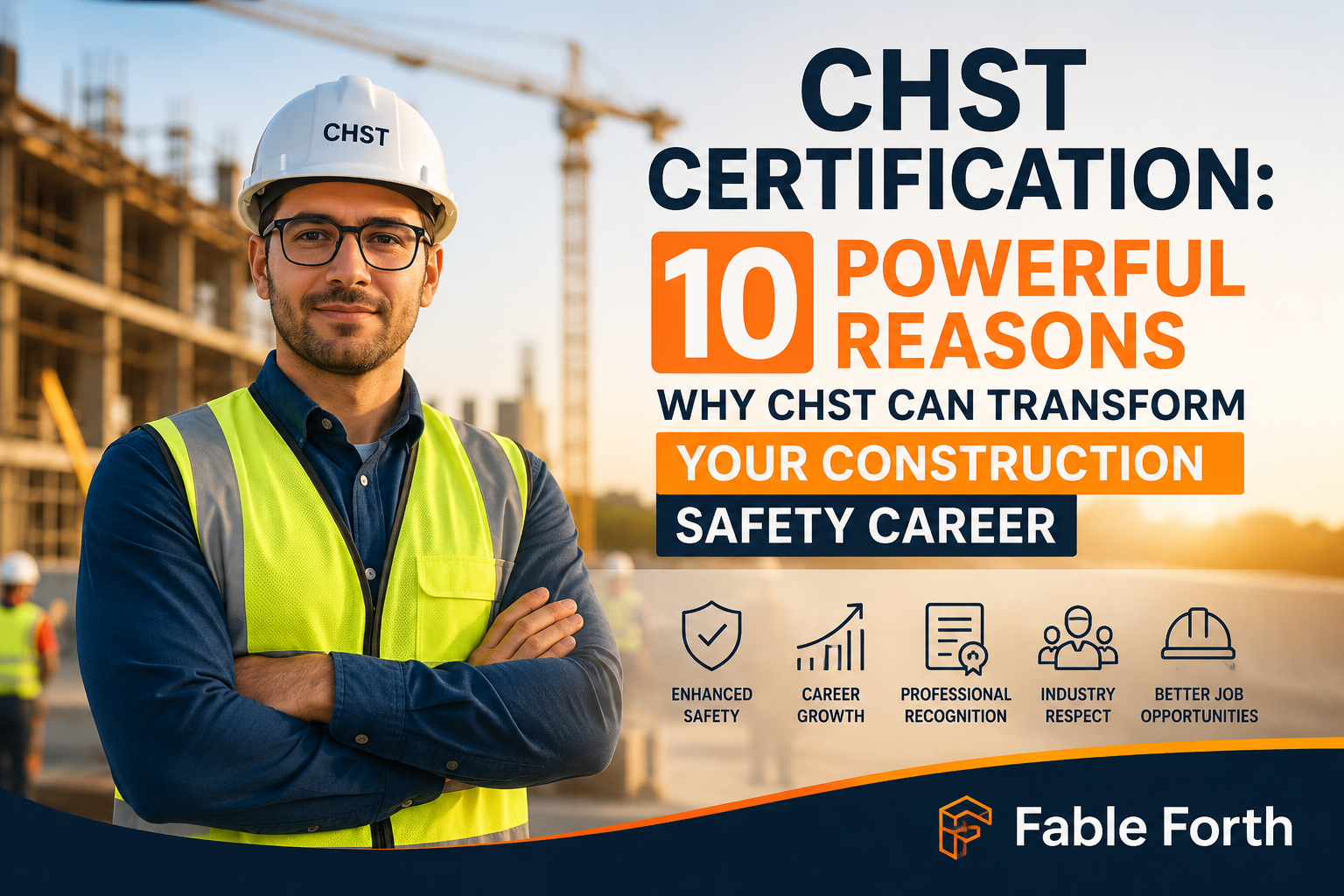
Introduction
The construction sector and industry is one of the most challenging, and risky in the world. Whether it’s building a new house or constructing a large commercial development, you need professionals to know how to locate hazards, minimize risks, and make a safer work environment. That is where the CHST credential can come in handy.
A CHST certification may be one of the best investments you can make if you’re seeking a rewarding career in construction safety or want to make a career leap to higher-paying leadership opportunities. Organizations are increasingly looking for certified employees to help keep them compliant, keep their employees safe and prevent expensive accidents.
This comprehensive guide will explain what it is, who should obtain a CHST, the benefits of having a CHST, and the information needed to prepare for and pass the CHST exam, as well as the career opportunities available and why CHST remains one of the most esteemed certifications in construction safety.
What Is CHST?
Construction Health and Safety Technician is the acronym for CHST. It is a professional certification that is specifically for individuals who are responsible for health and safety practices on construction job sites.
The qualification demonstrates a practitioner’s ability in:
- Hazard identification
- Risk assessment
- Construction safety regulations
- Accident prevention
- Emergency preparedness
- Safety inspections
- Worker protection
While general workplace safety certification courses teach workers the process of safely working around equipment and materials, It is specifically for the construction trade where hazards are constantly changing.
Why CHST Is So Valuable
The loss from accidents, injuries, and delays to construction projects costs millions of dollars annually to construction companies. Certified professionals will help to reduce these risks.
The following are some of the greatest benefits of CHST:
- Improved job opportunities
- Higher earning potential
- Industry recognition
- Greater employer confidence
- Better promotion opportunities
- Enhanced safety knowledge
- Professional credibility
Employers even specify CHST as a preferred or required qualification for safety-related jobs.
Who Should Earn CHST?
The certification is perfect for those who spend a great deal of time on construction sites supervising safety.
Examples include:
- Construction safety technicians
- Site safety coordinators
- Safety supervisors
- Field safety managers
- Project supervisors
- Construction foremen
- General contractors
- Safety consultants
Even more, highly skilled construction businessmen choose to enroll in it to prove their skills and get a competitive advantage in the job market.
Key Skills You Gain with CHST
The successful completion of CHST shows competency in various important safety skills.
Hazard Recognition
Certified individuals are taught to detect hazardous situations prior to becoming a serious accident.
Risk Assessment
You’ll learn how to assess jobsite risks and take action to control them.
OSHA Compliance
One of the key aspects of CHST is comprehending construction safety rules and staying in accordance with them.
Incident Investigation
Practitioners are taught how to investigate accidents, establish the root cause of the accident, and how to prevent future accidents.
Communication Skills
Communication of procedures, toolbox talks and training workers are important aspects of safety leadership.
CHST Exam Overview
The CHST exam tests knowledge in practical application of construction safety not memory.
The candidates are expected to answer questions on the following topics:
- Fall protection
- Excavation safety
- Electrical hazards
- Heavy equipment
- Fire prevention
- Personal Protective Equipment (PPE)
- Scaffolding
- Cranes and lifting operations.
- Confined spaces
- Emergency response
It takes practice and experience to be successful.
How to Prepare for the CHST Exam
When strategically prepared, the chances of scoring a perfect first-time pass are significantly high.
Study Official Materials
Use trusted study guides that are tailored for the CHST exam.
Take Practice Exams
Taking practice tests will help you pinpoint weaknesses and get a sense of what the exam will look like.
Review OSHA Standards
Many exam questions are based on construction safety regulations.
Study Daily
Dedicated time of 30-60 minutes a day can be highly beneficial for knowledge retention.
Join Study Groups
People learn from one another; other people’s perspectives and discussions are useful.
Career Opportunities After CHST
Earning a CHST certification is really beneficial because it opens up a lot of career paths.
Some common jobs that people with a CHST certification have include:
- Construction Safety Technician
- Safety Coordinator
- Health and Safety Specialist
- Field Safety Manager
- Safety Consultant
- Construction Inspector
- Project Safety Supervisor
- Environmental Health and Safety Professional
Many people who get a certification end up moving into management roles at some point in their CHST career. They can use the certification to get an up job in the CHST field.
Industries That Value CHST
Despite construction being the major industry seeking these certified personnel, there are other industries that are also eager to hire such professionals.
These include:
- Commercial construction
- Industrial construction
- Oil and gas
- Infrastructure projects
- Highway construction
- Bridge construction
- Manufacturing
- Utilities
- Renewable energy
Safety expertise is valuable anywhere there are large-scale construction projects.
Common Challenges During CHST Preparation
Many candidates go through the same challenges during their preparation journey.
Limited Study Time
I am pretty busy on my weekdays and sometimes I find it hard to fit in some time for studies.
Large Amount of Material
Construction safety encompasses many things that need to be reviewed carefully.
Test Anxiety
Practice Exams Help Build Confidence Before Exam Day
Balancing Work and Study
Creating a realistic weekly schedule will make preparation easier.
Tips to Pass CHST on Your First Attempt
Try these proven strategies to boost your odds of success:
- Create a study schedule
- Focus on weak subjects
- Take multiple practice exams
- Review incorrect answers carefully
- Understand concepts instead of memorizing
- Stay consistent
- Get adequate rest before the exam
- Manage your time during the test
Consistently studying for even 10 minutes per day can be more helpful than binge-studying for an hour every few days.
Benefits of CHST for Employers
Organizations also gain tremendous value by hiring certified professionals.
Benefits include:
- Reduced workplace accidents
- Lower insurance costs
- Improved OSHA compliance
- Higher employee confidence
- Better project efficiency
- Reduced downtime
- Enhanced company reputation
- Safer job sites
A strong safety culture benefits everyone involved.
Is CHST Worth It?
For many construction professionals, the answer is a resounding yes.
The certification demonstrates your commitment to workplace safety, advances your career prospects, and helps you build practical knowledge that can save lives.
Whether you’re just starting out in construction safety or looking to move up into leadership, CHST gives you a respected credential that’s recognized throughout the industry.
Investing in yourself is one of the best investments you can make. You’ll gain new skills, open up more doors for opportunity, receive accolades, and grow your career—all by putting in the effort to prepare.
Frequently Asked Questions
What does CHST stand for?
CHST stands for “Construction Health & Safety Technician”
Is CHST difficult?
While the exam can be challenging, candidates with construction experience and proper preparation have an excellent chance of success.
How long should I study for CHST?
Most candidates prepare for several weeks or months, depending on their experience and study time available.
Does CHST improve job opportunities?
Yes. Many employers actively seek certified safety professionals for supervisory and leadership positions.
Can experienced construction workers benefit from CHST?
Absolutely! It not only validates your hands-on experience but also builds up your credibility as a professional.
Conclusion
The CHST® certification isn’t just another credential—it’s a smart investment in your future. Equipping construction safety pros with the knowledge, confidence, and credibility they need to make job sites safer and open doors to better career opportunities and earning potential.
Whether you’re an experienced safety tech, a supervisor looking to level up, or just someone passionate about keeping workers safe, CHST can help you stand out in a competitive field. Start prepping today, commit to lifelong learning, and take the next step towards becoming a go-to leader in construction health & safety.
