

Introduction
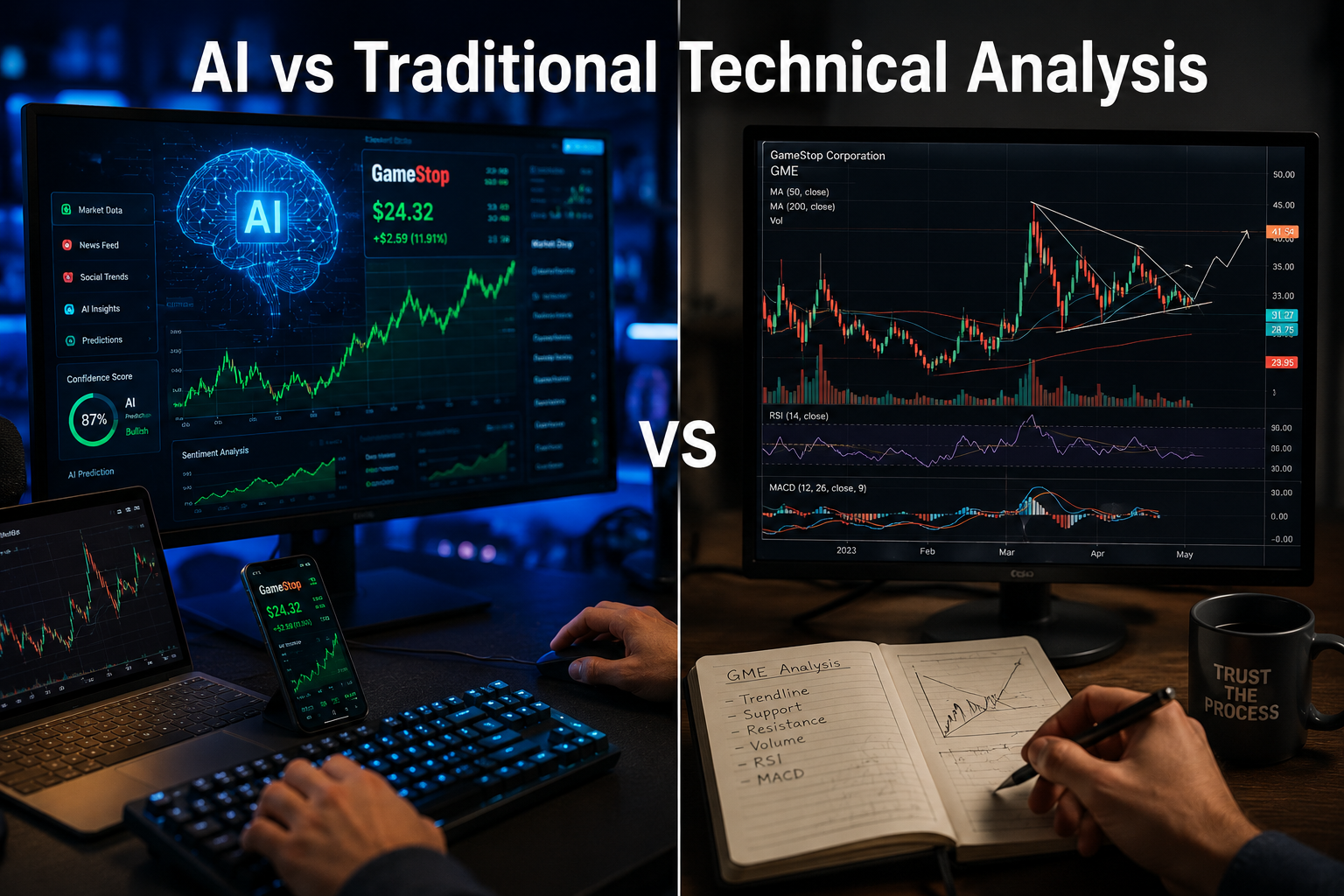
The short answer: gme ai platforms generally outperform traditional technical indicators when it comes to identifying early momentum in high-volatility stocks like GameStop, but they should never be used as a standalone trading system. AI-driven analytics can process market sentiment, breaking news, and trading activity in near real time, while traditional indicators remain essential for confirming trends and managing risk.
For retail investors and active traders in the United States, the most effective strategy is to combine gme ai insights with proven technical analysis. AI can help uncover opportunities earlier, while traditional chart indicators help determine whether those opportunities are worth acting on.
Quick-Glance Comparison Matrix
| Feature | Danelfin AI | Finnhub AI | Traditional Technical Analysis |
| Typical Pricing (USD) | $29–$99/month | Free API tier with premium plans | Free–$70/month depending on platform |
| AI Sentiment Parsing | Medium (news-focused) | High (news + API integrations) | Not Available |
| Reddit/X Chatter Tracking | Limited | Moderate with integrations | Not Supported |
| Predictive Speed | Very Fast | Near Real-Time | Lagging |
| Ease of Use | Beginner Friendly | Better for advanced users | Moderate |
| Best For | Swing Traders | Active Traders & Developers | Technical Analysts |
Predictive Accuracy in High-Volatility Environments
GameStop has always been different from traditional large-cap stocks. While most companies move based on earnings reports or long-term fundamentals, GME often reacts to retail investor enthusiasm, options activity, viral news, and social media momentum. That creates an environment where timing matters just as much as analysis.
Traditional technical indicators still play an important role, but they often react after price movements have already begun. In contrast, modern gme ai platforms attempt to identify changing market conditions before they become obvious on a chart.
Why Traditional Indicators Often Lag
Classic technical analysis relies entirely on historical market data. Indicators such as RSI, Moving Averages, and MACD calculate their signals using previous price action, which means they naturally respond after a trend has already started.
For stable blue-chip stocks, this delay is usually acceptable. However, highly volatile meme stocks like GameStop can gain or lose significant value within hours, leaving traditional indicators several steps behind the market.
Some common examples include:
- RSI may signal an overbought condition only after a major rally has already occurred.
- Moving Average crossovers often appear after momentum has shifted.
- MACD signals usually confirm trends instead of predicting them.
- Support and resistance levels work well but cannot anticipate sudden news-driven price spikes.
These indicators remain useful because they help traders validate trends, but they rarely provide the earliest warning of rapid momentum changes.
How gme ai Attempts to Stay Ahead
Unlike traditional charting tools, gme ai systems analyze far more than historical prices. Advanced AI models continuously scan multiple sources of market information to estimate where buying or selling pressure may develop before price action confirms the move.
Rather than focusing on one chart, AI combines information from several channels simultaneously. This broader view allows predictive models to recognize subtle changes that would be difficult for individual traders to detect manually.
Many modern AI platforms monitor:
- Financial news headlines
- Company announcements
- Earnings reports
- Trading volume anomalies
- Options market activity
- Historical price behavior
- Market-wide volatility
- Retail investor sentiment
This combination of structured and unstructured data allows AI to react much faster than traditional indicators that rely only on completed price candles.
Speed Matters During GameStop Rallies
Few stocks demonstrate the importance of speed better than GameStop. A surge in retail buying can quickly trigger options activity, increased media attention, and even more buying pressure. Those chain reactions can push prices sharply higher before traditional indicators fully recognize the trend.
This is one reason many active traders have started using gme ai stock prediction platforms as part of their daily research process. AI systems attempt to identify unusual trading behavior early, giving traders additional time to evaluate potential opportunities before momentum becomes obvious across the broader market.
Even so, speed should never be confused with certainty. AI models produce probability-based forecasts rather than guaranteed outcomes, and unexpected market events can invalidate even the strongest predictive signals.
The Limits of AI Forecasting
Despite impressive technological advances, AI cannot predict every market movement. Financial markets remain influenced by countless variables, including economic data, regulatory decisions, institutional trading, geopolitical events, and investor psychology.
For example, an unexpected SEC announcement or a surprise corporate filing can completely change market direction within minutes. No predictive model can eliminate that uncertainty, regardless of how sophisticated its algorithms may be.
This is why experienced traders rarely rely exclusively on AI-generated forecasts. Instead, they combine predictive analytics with disciplined technical analysis and sound risk management before placing trades.
Traditional Analysis Still Provides Confirmation
Although AI often identifies opportunities earlier, traditional technical indicators remain essential for confirming whether a trade has real strength. Professional traders continue using these tools because they provide objective evidence based on actual market behavior rather than probability estimates.
Several indicators remain particularly valuable when trading GameStop:
- Relative Strength Index (RSI): Helps identify potentially overbought or oversold conditions.
- Moving Averages: Reveal broader market trends despite their slower reaction speed.
- Volume Analysis: Confirms whether buying or selling pressure supports the current move.
- Support and Resistance: Highlights price levels where market participants have historically entered or exited positions.
Many AI platforms actually incorporate these same indicators into their predictive models. Instead of replacing technical analysis, they enhance it by adding sentiment analysis, news interpretation, and broader market intelligence.
Which Approach Performs Better?
The answer depends on what traders expect from their tools. If the goal is identifying early momentum in fast-moving meme stocks, AI generally has the advantage because it analyzes far more information than traditional chart indicators.
However, if the objective is confirming whether a breakout is sustainable, classic technical analysis still provides some of the most reliable signals available. Professional traders rarely treat these methods as competitors because each addresses different parts of the decision-making process.
The strongest trading strategy combines both approaches. AI helps identify opportunities before the crowd notices them, while technical analysis helps determine whether those opportunities deserve real capital.
Sentiment Analysis vs Raw Mathematics
Traditional technical analysis and AI-powered investing approach the market from two very different perspectives. Classic indicators focus entirely on price, volume, and historical trading data, while gme ai platforms attempt to understand the behavior driving those numbers.
That distinction matters because GameStop has repeatedly demonstrated that retail sentiment can influence price action long before traditional indicators react. For traders who actively follow meme stocks, understanding investor psychology has become almost as important as reading a price chart.
How AI Reads Market Sentiment
Modern AI trading platforms process enormous amounts of information every minute. Instead of relying only on candlestick patterns, they evaluate text, news, and online discussions to determine whether market sentiment is becoming more bullish or bearish.
Common data sources include:
- Financial news websites
- SEC filings
- Earnings reports
- Analyst ratings
- Reddit discussions
- X (formerly Twitter) posts
- Market commentary
- Options flow data
By combining these data points, AI attempts to estimate whether buying pressure is increasing before that momentum becomes obvious on a chart.
Why Social Media Matters for GameStop
Few stocks are as closely tied to online communities as GameStop. Since the meme-stock rally, platforms like Reddit and X have become major sources of trading ideas, speculation, and market-moving discussions.
As a result, many traders now use a wallstreetbets AI sentiment tracker to monitor changing investor behavior. Instead of manually reading thousands of posts, AI systems analyze engagement patterns, posting frequency, trending keywords, and overall sentiment within seconds.
Several factors are commonly monitored, including:
- Bullish versus bearish language
- Post engagement and upvotes
- Trending keywords
- Community activity levels
- Rapid changes in discussion volume
Although social sentiment should never replace technical confirmation, it often provides an early indication that market attention is shifting toward a particular stock.
Traditional Indicators Focus on Price Alone
Classic chart indicators ignore everything except market data. RSI, MACD, Bollinger Bands, and Moving Averages calculate signals using mathematical formulas based entirely on previous price movements.
This makes them objective and easy to interpret, but it also means they cannot recognize why a market is moving. A sudden increase in bullish Reddit discussions or breaking corporate news will not appear in these indicators until prices begin adjusting.
That limitation becomes more noticeable during highly volatile trading sessions where sentiment changes much faster than traditional indicators can respond.
Can Sentiment Analysis Produce False Signals?
Absolutely. Social media excitement does not always translate into sustained buying pressure, and AI models occasionally mistake short-term hype for genuine momentum.
For example, a viral post may trigger a temporary increase in online discussions without attracting enough actual buyers to move the stock significantly. Traders who rely only on sentiment analysis risk entering positions based on excitement rather than confirmed market strength.
This is why experienced traders typically wait for technical confirmation before acting on AI-generated alerts.
gme ai Stock Prediction: How Reliable Is It?
One of the biggest misconceptions surrounding AI investing is that it can accurately predict tomorrow’s stock price. Many investors searching for gme ai stock prediction expect an exact forecast, but professional trading simply doesn’t work that way.
Markets remain unpredictable because prices respond to countless variables, including economic reports, institutional trading, interest rates, corporate announcements, and investor psychology. No algorithm can consistently account for every factor influencing a stock’s next move.
What AI Actually Predicts
Rather than forecasting exact prices, AI platforms estimate probabilities. They evaluate whether current market conditions favor continued bullish momentum, increasing downside risk, or a period of consolidation.
Most predictive systems generate insights such as:
- Trend strength
- Probability of upward momentum
- Downside risk
- Expected volatility
- Market sentiment score
- Confidence level for current trends
These probabilities help traders make more informed decisions instead of relying on emotional reactions.
Strengths of AI Forecasting
AI offers several advantages that traditional analysis cannot easily match. Its greatest strength is processing massive datasets in real time without becoming overwhelmed.
Some of its strongest capabilities include:
- Monitoring thousands of financial news stories.
- Tracking social media discussions continuously.
- Detecting unusual trading volume.
- Identifying recurring historical patterns.
- Updating forecasts as new information becomes available.
For active traders, these capabilities can provide valuable context before making high-risk trading decisions.
Where AI Falls Short
Despite its speed, AI has important limitations. Every prediction is based on historical relationships and statistical probabilities, which means unexpected events can quickly invalidate previous forecasts.
Examples include:
- Surprise earnings announcements
- Regulatory investigations
- Trading halts
- Geopolitical events
- Major economic reports
- Sudden institutional selling
These events remind traders that AI should support decision-making—not replace it.
GameStop Algorithmic Trading vs Human Decision-Making
Interest in gamestop algorithmic trading has grown significantly as AI-powered investing becomes more accessible. Automated systems can monitor markets twenty-four hours a day, execute trades instantly, and follow predefined rules without emotional interference.
For many traders, removing fear and greed from the decision-making process is one of the biggest advantages of automation.
Benefits of Algorithmic Trading
AI-driven trading systems provide several practical benefits, particularly during periods of extreme market volatility.
Key advantages include:
- Faster trade execution
- Consistent rule-based decisions
- Continuous market monitoring
- Reduced emotional bias
- Improved research efficiency
These strengths make algorithmic tools attractive for active traders who cannot monitor markets every minute of the trading day.
Why Human Judgment Still Wins
Algorithms excel at recognizing patterns, but they lack intuition and market experience. Experienced traders can evaluate unusual situations that historical datasets may never have encountered.
For example, sudden policy changes, unexpected executive announcements, or extraordinary market events often require judgment rather than statistical analysis. Human experience remains valuable when markets behave in ways that algorithms did not anticipate.
The most successful traders combine both approaches. They use AI to identify potential opportunities and then apply technical analysis, risk management, and personal experience before committing capital.
Best Retail Investor AI Tools 2026
The AI investing landscape has become increasingly competitive, giving retail investors access to sophisticated research tools that were once available only to institutional trading firms. The best retail investor AI tools 2026 focus on improving research speed, identifying emerging trends, and helping traders make better-informed decisions.
Rather than replacing trader experience, these platforms function as intelligent research assistants that analyze vast amounts of market information in seconds.
Popular Categories of AI Investing Tools
Modern AI platforms specialize in different areas of market analysis. Many traders combine multiple tools instead of relying on a single service.
Popular categories include:
- AI stock-rating platforms
- Predictive analytics software
- Market sentiment scanners
- Options flow trackers
- Portfolio risk analyzers
- Financial news intelligence platforms
- Trading signal generators
Each category serves a different purpose, making it easier for traders to build a research workflow tailored to their investment style.
Danelfin AI vs Finnhub AI
Danelfin AI is designed primarily for investors who prefer simple AI-powered stock ratings and easy-to-read predictive scores. Its interface is beginner-friendly, making it a popular choice among swing traders and retail investors.
Finnhub takes a different approach by offering extensive APIs, real-time financial data, and customizable integrations. Advanced traders and developers often prefer Finnhub because it allows deeper analysis and greater flexibility when building personalized trading systems.
Choosing the Right AI Platform
No single AI platform is perfect for every investor. The best choice depends on trading style, experience level, and the type of market information a trader values most.
Before subscribing to any platform, consider factors such as:
- Data quality
- Update frequency
- Sentiment analysis capabilities
- Ease of use
- Pricing
- Integration options
- Customer support
Experienced traders often test multiple services before deciding which platform fits their workflow. The goal is not to find an AI that predicts every market move but one that consistently improves research quality and supports disciplined decision-making.
Where Bloomberg Terminal Still Fits
AI-powered investing platforms have become increasingly capable, but Bloomberg Terminal continues to hold a unique position in professional finance. It remains one of the most comprehensive sources for real-time market data, corporate financials, economic indicators, fixed-income analytics, and breaking financial news.
For institutional traders, portfolio managers, and investment banks, Bloomberg Terminal is often considered the industry standard. However, its subscription cost places it well outside the budget of most retail investors, making AI-driven alternatives far more practical for everyday trading.
Bloomberg Terminal vs AI Platforms
Although both serve investors, they solve different problems. Bloomberg Terminal focuses on delivering institutional-grade data, while AI platforms focus on turning that data into actionable insights.
Here’s how they compare:
| Feature | Bloomberg Terminal | AI Investing Platforms |
| Primary Purpose | Professional market research | Predictive market analysis |
| Target Users | Institutions & Professionals | Retail Investors & Traders |
| Real-Time News | Excellent | Very Good |
| AI Predictions | No | Yes |
| Sentiment Analysis | Limited | Advanced |
| Retail Affordability | Low | High |
For most retail traders, AI software provides a better balance between cost and functionality. Professional-grade data is valuable, but actionable insights often matter more than having access to every available financial metric.
Should Retail Traders Skip Bloomberg?
Not necessarily. Traders who manage large portfolios or require deep institutional research may still benefit from Bloomberg Terminal.
However, many retail investors can build an effective research workflow by combining:
- AI-powered predictive analytics
- Traditional technical indicators
- Reliable financial news
- Earnings reports
- Risk management tools
This approach delivers a significant amount of market intelligence without the premium cost of institutional software.
Pros & Cons of Using gme ai
Every trading tool has strengths and weaknesses, and gme ai is no exception. Understanding both sides helps investors avoid unrealistic expectations.
Pros
- Detects changing market sentiment quickly.
- Monitors multiple data sources simultaneously.
- Processes financial news in near real time.
- Identifies unusual trading activity faster than manual research.
- Reduces emotional decision-making.
- Helps traders discover opportunities before they become obvious.
- Supports both day trading and swing trading strategies.
Cons
- Predictions are based on probabilities, not certainty.
- False signals can occur during periods of social media hype.
- AI models cannot predict unexpected market events.
- Different platforms may provide conflicting forecasts.
- Overreliance on AI can lead to poor risk management.
- Subscription costs vary and may increase over time.
The smartest traders recognize that AI is a decision-support tool rather than an automatic profit machine. Successful investing still depends on discipline, patience, and consistent execution.
Best Practices for Combining AI With Technical Analysis
Rather than choosing between AI and traditional indicators, experienced traders often combine both to create a stronger trading process.
A balanced workflow may look like this:
- Use gme ai to identify unusual market activity or changing sentiment.
- Check financial news to understand the reason behind the movement.
- Confirm the trend using RSI, Moving Averages, and volume analysis.
- Locate support and resistance levels before entering a trade.
- Manage risk with predefined stop-loss and profit targets.
- Review the trade after completion to improve future decision-making.
This structured approach reduces emotional decisions while increasing confidence in each trading setup.
The Verdict
For retail investors who actively trade GameStop, gme ai offers a meaningful advantage when used responsibly. AI excels at processing massive amounts of market data, identifying changes in investor sentiment, and highlighting opportunities that traditional indicators may not recognize until much later.
However, faster information does not automatically translate into better trades. Markets remain unpredictable, and no algorithm can consistently forecast every price movement. Unexpected earnings surprises, regulatory announcements, or sudden shifts in market sentiment can quickly invalidate even the strongest AI prediction.
Traditional technical analysis continues to provide the discipline that every trader needs. Indicators such as RSI, Moving Averages, support and resistance, and volume analysis help confirm whether an AI-generated signal is supported by actual buying or selling pressure. This confirmation process reduces the likelihood of chasing hype-driven moves.
If you are an active day trader or swing trader focused on high-volatility stocks, AI-powered research tools can improve your preparation and reaction time. They are especially valuable for monitoring sentiment, unusual options activity, and breaking financial news that may influence short-term price action.
Long-term investors, on the other hand, may find that traditional technical analysis combined with strong fundamental research remains sufficient for building wealth over time. AI can still add value, but it becomes a complementary research tool rather than the center of the investment process.
The most successful traders are not choosing between AI and technical analysis—they are combining both. AI identifies opportunities earlier, while technical indicators help verify those opportunities before capital is committed. That combination creates a more disciplined, data-driven trading strategy capable of adapting to today’s fast-moving markets.
Conclusion
The debate surrounding gme ai is no longer about whether artificial intelligence belongs in modern trading—it already does. The real question is how investors can use it effectively without abandoning the proven principles of technical analysis and risk management.
For GameStop traders, AI delivers speed, broader market awareness, and powerful sentiment analysis. Traditional indicators contribute structure, confirmation, and consistency. Together, they provide a more complete picture of market behavior than either approach can offer alone.
As AI technology continues to improve throughout 2026 and beyond, retail investors will gain access to increasingly sophisticated research tools. Those who combine predictive analytics with disciplined chart analysis, sound position sizing, and emotional control will be in the strongest position to navigate one of the market’s most volatile trading environments.
Frequently Asked Questions (FAQ)
Is gme ai better than traditional technical analysis?
Not entirely. gme ai is generally better at detecting early shifts in market sentiment and momentum, while traditional technical analysis is more effective for confirming trends and managing trade entries and exits. Using both together typically produces stronger results than relying on either method alone.
Can gme ai accurately predict GameStop stock prices?
No AI platform can consistently predict exact stock prices. Most gme ai stock prediction tools estimate probabilities, trend strength, volatility, and market sentiment rather than guaranteeing future price movements.
What is the biggest advantage of AI trading platforms?
Their biggest advantage is speed. AI systems can process financial news, social media discussions, earnings reports, and trading data in near real time, helping traders identify opportunities faster than manual research.
Do professional traders still use RSI and Moving Averages?
Yes. Despite advances in AI, professional traders continue using RSI, Moving Averages, volume analysis, and support and resistance levels because they provide objective confirmation before entering or exiting trades.
Which type of trader benefits most from gme ai?
Active day traders and swing traders generally benefit the most because they rely on rapid market analysis and timely information. Long-term investors may still find AI useful, but traditional fundamental analysis usually plays a larger role in their investment decisions.
