

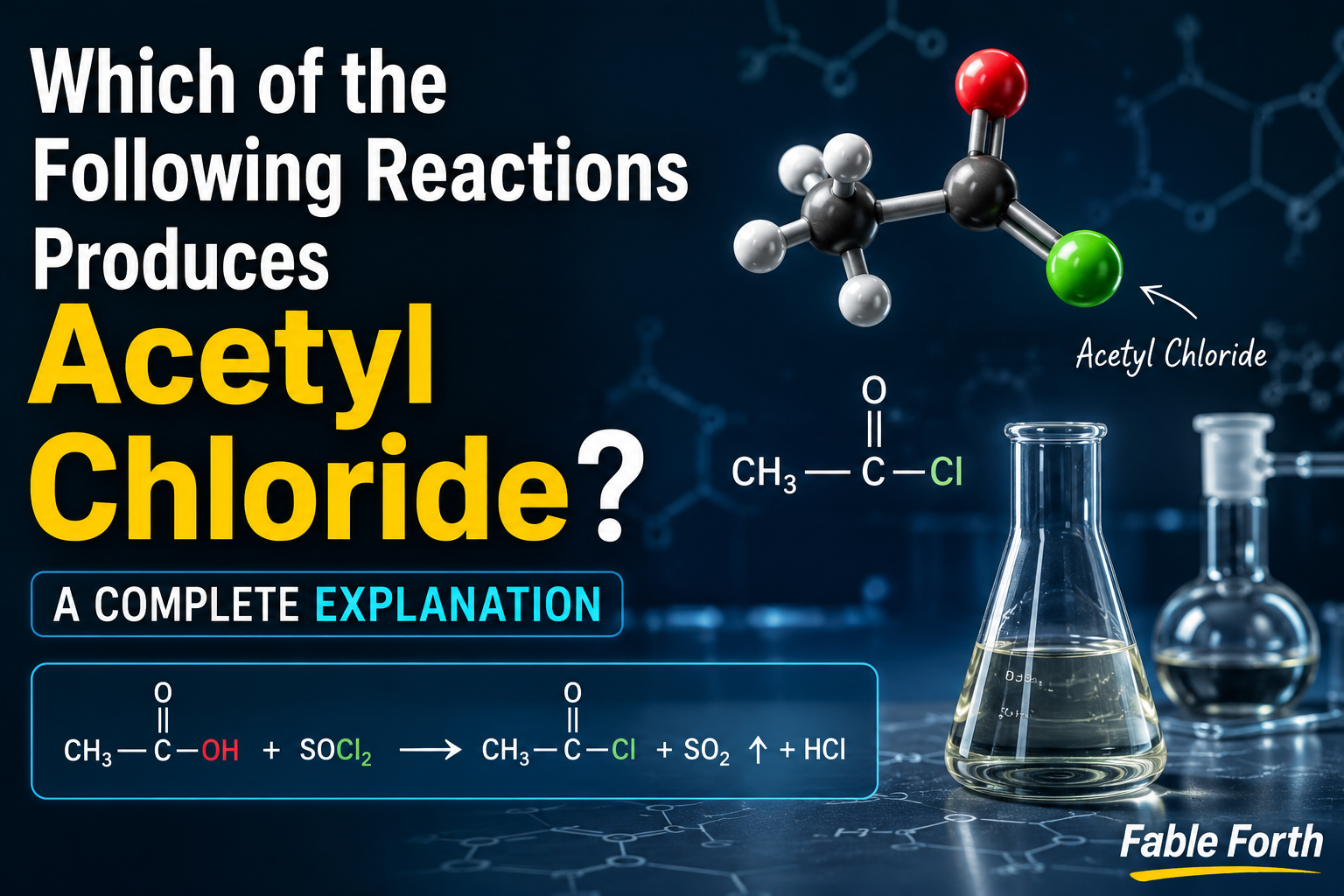
The fact that you are trying to find an answer to “Which of the following reactions produces acetyl chloride” might be because you are taking an organic chemistry test, an MCQ, or an exam.
Acetyl chloride (CH3COCl) is one of the many acid chlorides of great importance in lab- and large-scale industrial synthesis processes.
Answer: CH3COOH (Acetic acid) reacts with a chlorinating agent such as SOCl (thionyl chloride), PCl5 (phosphorus pentachloride), or PCl3 (phosphorus trichloride) to produce CH3COCl (acetyl chloride).
Which of the Following Reactions Produces Acetyl Chloride?
The most common organic reaction is:
CH₃COOH + SOCl₂ → CH₃COCl + SO₂ + HCl
In this reaction:
- CH₃COOH = Acetic acid
- SOCl₂ = Thionyl chloride
- CH₃COCl = Acetyl chloride
- SO₂ = Sulfur dioxide
- HCl = Hydrogen chloride
This method is favorable as the products other than acetyl chloride are gases. This greatly simplifies the purification of acetyl chloride.
Why Is Thionyl Chloride Preferred?
Chemists have several advantages to pick up thionyl chloride SOCl:
- High product yield
- Easy purification
- Minimal contamination
- Gaseous by-products leave the reaction mixture
- Common laboratory reagent
Consequently, it seems common in chemical books and competitive exams.
Other Reactions That Produce Acetyl Chloride
There are several alternative methods besides thionyl chloride. The primary use of this molecule is to make acetyl chloride by various chlorinating agent reactions.
1. Using Phosphorus Pentachloride (PCl₅)
CH₃COOH + PCl₅ → CH₃COCl + POCl₃ + HCl
In addition, it converts acetic acid to acetyl chloride, while producing phosphorus oxychloride as a side product.
2. Using Phosphorus Trichloride (PCl₃)
3CH₃COOH + PCl₃ → 3CH₃COCl + H₃PO₃
This procedure works but is seldom used when thionyl chloride can be used.
What Is Acetyl Chloride?
This acid chloride is obtained from acetic acid.
Chemical Formula
CH₃COCl
Properties
- Colorless liquid
- Highly reactive
- Moisture sensitive
- Strong acylating agent
- Corrosive in nature
It must be kept in airtight sealed cans as it reacts with water very fast.
Common MCQ Answer
A common exam question looks like this:
Which of the following reactions produces acetyl chloride?
- Acetic acid + Sodium hydroxide
- Acetic acid + Thionyl chloride
- Ethanol + Hydrochloric acid
- Methane + Chlorine
Correct Answer: B. Acetic acid + Thionyl chloride
Uses of Acetyl Chloride
There are three principal applications for acetyl chloride in Organic Synthesis:
- Manufacturing pharmaceuticals
- Preparing esters
- Producing amides
- Acylation reactions
- Laboratory organic synthesis
- Dye and fragrance production
Chemical Manufacturers can use the high reactivity of this chemical.
Why Does Acetyl Chloride React Quickly With Water?
Another factor as to why it is highly reactive is the reaction known as hydrolysis.
Where:
CH₃COCl + H₂O → CH₃COOH + HCl
This will create acetic acid and hydrochloric acid and release heat.
Tips to Remember the Reaction
A common memory trick for the reaction is the simple rule:
Acetic Acid + SOCl₂ = Acetyl Chloride
Remember:
- Acid → Acid Chloride
- SOCl₂ is the preferred chlorinating reagent
- SO₂ and HCl escape as gases
This shortcut works well for the board exams and other exams such as NEET, JEE, and university examinations, chemistry entrance exams.
Frequently Asked Questions
Which reagent is most commonly used to produce acetyl chloride?
Thionyl chloride (SOCl) is the reagent most widely employed for it provides satisfactory yields.
Can acetyl chloride be prepared from acetic acid?
Yes. Acetic acid with thionyl chloride or with phosphorus trichloride or with phosphorus pentachloride gives acetyl chloride.
Why is SOCl₂ preferred over PCl₅?
Since SOCl reacts to produce gases as side products: O and HCl.
What is the chemical formula of acetyl chloride?
The chemical formula of acetyl chloride is CH₃COCl.
Is acetyl chloride soluble in water?
Nope. Instead, it rapidly reacts with the water to produce both hydrochloric acid and acetic acid.
Conclusion
You could have the answer to this question be something similar. If you are asked a question:
Which of the following answers will create acetyl chloride? The answer is:
To use thionyl chloride (SOCl) and acetic acid (CH3COOH).
The answer is to use thionyl chloride (SOCl) and acetic acid (CH3COOH). This should answer this question sufficiently for you in any exam you might be having.
CH₃COOH + SOCl₂ → CH₃COCl + SO₂ + HCl
This reaction is the most common preparation of acetyl chloride in the laboratory as it yields excellent results. The byproducts are gaseous and therefore easily removable. If you study the reaction along with its mechanism and uses, you will be able to tackle MCQs regarding this reaction without difficulty and bolster your knowledge of organic chemistry.
