

Quick Answer: Fable Forth for Sale ka matlab hamesha ek specific product listing nahi hota. Ye phrase kisi product, brand, website, digital asset, company, ya third-party listing ko refer kar sakta hai. Buyers ko purchase se pehle seller, official sources, product details, pricing, payment method, and return terms carefully verify karne chahiye.
Introduction
Many people using a Fable forth for sale search query would anticipate that they would stumble upon a listing of goods or a brand for purchase, but unfortunately, not all search term inquiries that feature for sale result in a clean web product result or even an organized storefront marketplace result. Some search phrase queries are attached to brands, and then some will utilize a slight variant of a spelling or a mistyped, accidental question, or a question created by a person trying to find something hard for online indexing. It’s a similar sort of situation with the Fable Forth for sale inquiries.
At press time, there aren’t any apparent, verifiable instances of a Fable Forth consumer brand item catalog being up for sale through traditional means.
This particular instance is, in a sense, about tech and editorial content around technology news, business, and all things digital and new apps or AI development.
A person searching for Fable Forth for sale could be looking for:
- A product they believe is connected to Fable Forth
- A business or website associated with the name
- A resale listing
- A technology product mentioned in an article
- A brand with a similar name
- A typo or alternative spelling
- A service or digital asset
The safest and most practical means to perform these kinds of queries is to either invent a product or invent the existence of such a product without research-and this is not sensible when an end customer or an expert seeks answers from the Web-as the end customer or expert’s first thought needs to be regarding: 1. What kind of item is being marketed? 2. Who is selling the item? 3. Is the seller reliable?
What Does “Fable Forth for Sale” Actually Mean?
| Search Phrase | Possible Intent |
|---|---|
| Brand name for sale | Someone looking for a brand |
| Website name for sale | A website or digital asset |
| Product name price | A product purchase |
| Company name buy | Business or company acquisition |
| Brand name official store | Official shopping source |
The phrase Fable Forth for sale comprises two key pieces. First, “Fable Forth,” the name of what seems to be a publication, but a name nonetheless. Secondly, “for sale,” which would imply intent to buy.
The two components can combine to infer that some users may be seeking Fable Forth-related content in a purchasing fashion.
Though a keyword in itself, never implies there is a product at all. That’s arguably one of the first lessons ever to be learned from online search technology of today. Most search phrases are born at a pace before which the search engine can properly infer the intent.
For example, a user might search:
- “brand name for sale”
- “website name for sale”
- “product name price”
- “company name buy”
- “brand name official store”
Even if there is no official product page, search engines are still likely to provide relevant results. This is the reason that you should think about more than the word if a study should be honest.
A shopper should ask:
- What is the exact item?
- Is there an official seller?
- Is the listing connected to the real brand?
- Does the seller provide verifiable information?
- Is the product legally available in the buyer’s location?
To help prevent any confusion and prevent issues such as purchasing from a duplicate listing or impersonator, consider using the following questions.
Is Fable Forth a Product Available for Sale?
From the information looked at in researching this article, it is unlikely we should assume this is a sale product, so I don’t think Fable Forth should have been seen as a sale product.
The Fable Forth site is a publishing website, not an e-commerce site. The site publishes news on Topics related to technology, AI, apps, business, news, and digital trends.
However, this means that anyone searching for ” Fable Forth ” for sale needs to be cautious about believing any “match” with the same name is actually sanctioned by Fable Forth.
There are many products with similar names in marketplaces online. One product could have the word “Fable” in its name while another can have the word “Forth.” It can be in different brands, books, software services, collectibles, or whatever.
Having a similarly stated phrase does not automatically make it the same business, which is why brand authenticity is crucial. If there is any list making use of ‘Fable Forth’ to market an item, you will probably want to ensure:
- Whether the listing links to an official website
- Whether the brand name matches exactly
- Whether the seller provides verifiable business information
- Whether the product is mentioned on official channels
- Whether the listing contains realistic product details
- Whether the payment and return policies are clear
There must be even greater care taken when the listing may be linked to no source whatsoever, or one that is difficult to trace.
Why “For Sale” Searches Can Be Confusing
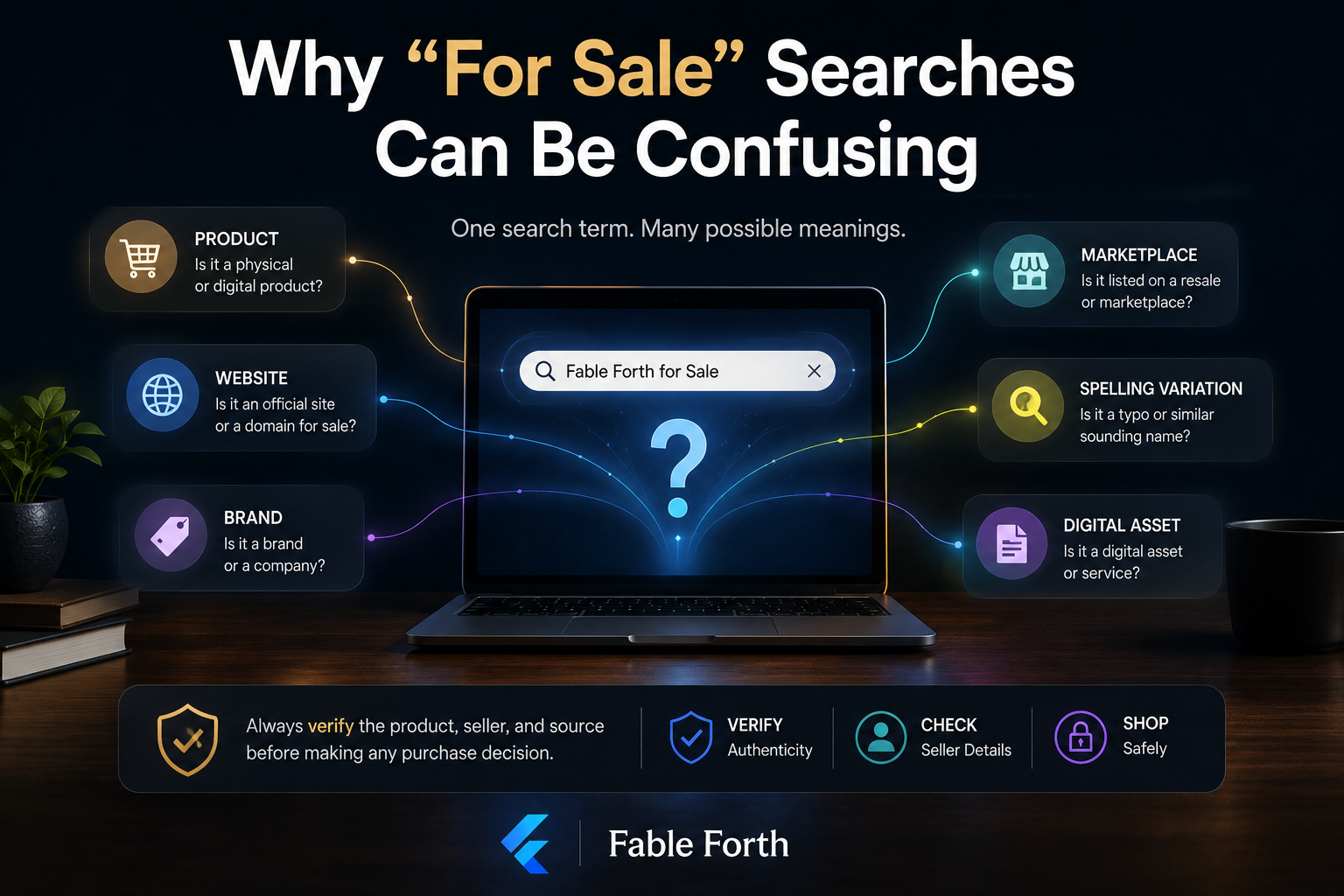
There are millions of product pages, second-hand sale listings, brand names, advertisements, and other e-commerce pages online. Search Engines have to deduce the meaning behind terse text snippets.
The expression “Fable forth for sale” is particularly intriguing as it involves a combination of:
- A brand-like phrase
- A commercial intent
- Potential spelling ambiguity
Search engines may interpret “Fable Forth” as:
- A company
- A website
- A product
- A fictional name
- A spelling variation
- Two separate terms
Some results might even be from different pages not relevant to your original search. A search query with a term that means different things to different people could potentially surface a diverse array of results in connection to “Fable”. The same confusion for search engines would apply to a word like “forth.”
These result to entity ambiguity (a phrase that should be familiar to SEO pros).
In a word, it’s when search engines aren’t aware of which entity related to your query is appropriate for your search term. One definition of the term is “a distinct person, product, place or organization used for informational reference purposes”.
That is to say, search engines use the query to guide you toward information about one instance of a word when others also exist – this includes people, companies, products and more. In that context, whenever applicable, you may also want to accompany your search query with words you want to include.
Instead of searching only:
Fable forth for sale
a user may need to search:
- Fable Forth official website
- Fable Forth product
- Fable Forth company
- Fable Forth store
- Fable Forth website sale
- Fable Forth domain for sale
The added context can help narrow the search.
How to Verify a Fable Forth Listing Before Buying
| Verification Step | What to Check |
|---|---|
| Official Website | Is the listing connected to the official website? |
| Seller | Business name and contact information |
| Product Details | Clear description and realistic specifications |
| Price | Compare with similar listings |
| Payment | Use secure payment methods |
| Returns | Check return and refund policies |
It is always important to do the verification if you see a listing using the brand name Fable Forth for sale. Don’t go for the image, the sound of a brand name, or an unusually low price.
Check the Official Website
Go to the main brand or company website. This step establishes that the company itself is selling the product. Items might be sold on a marketplace, but not found on the original company website.
This isn’t proof that an item is counterfeit but may warrant further investigation.
Check the Seller
Look for:
- Business name
- Contact information
- Customer service details
- Return policy
- Privacy policy
- Terms of sale
Your seller should be able to explicitly tell you exactly who this transaction will take place with.
Review the Product Details
Be cautious if a listing contains:
- Extremely vague descriptions
- Unusual spelling mistakes
- Stolen-looking images
- No specifications
- No return information
- Pressure to pay immediately
A professional listing should clearly explain what is being sold.
Compare the Price
Extremely low prices can also be something to look out for. Again, this doesn’t say that everyone who offers discounts is selling something fraudulent. There will still be sellers that offer genuine sales prices or discounts on refurbished goods.
A significant amount between this bargain price and the prices from a few other retailers does warrant extra attention, though.
The Difference Between an Official Sale and a Third-Party Listing
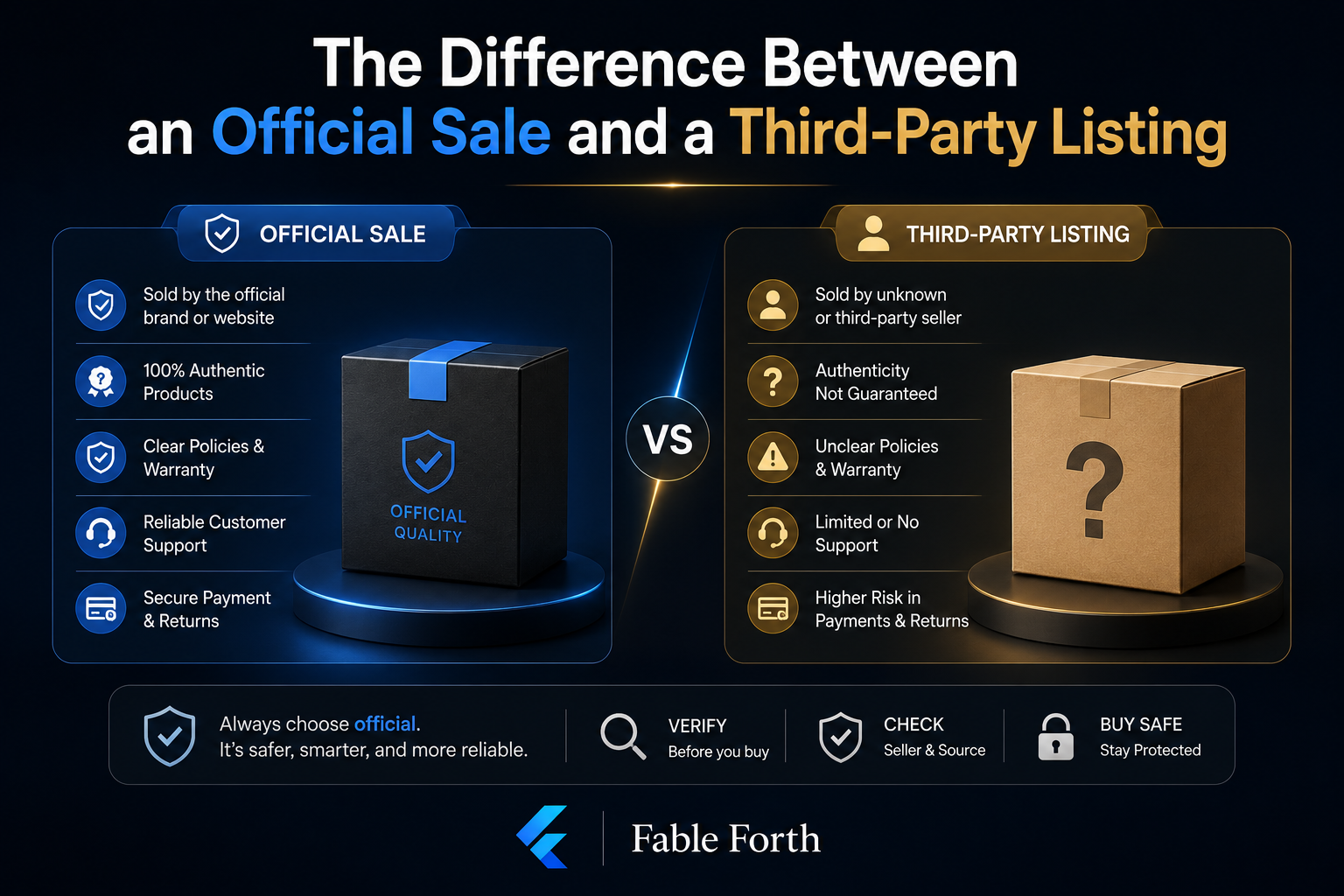
However, for a Fable for sale, this is arguably the biggest difference you’ll find between an official sale and a third-party sale. With the latter, a Fable for sale is very often:
- The brand itself
- An authorized retailer
- An officially recognized distributor
A third-party listing may be posted by:
- An independent seller
- A reseller
- A marketplace user
- A collector
- An unaffiliated business
These listings are by a third party, and the listings may be real, but a company cannot claim there is a listing and assume endorsement.
Thus, a buyer should confirm:
- Who owns the listing?
- Who ships the product?
- Who handles returns?
- Is the seller authorized?
- Is the product new, used, or digital?
- Does the seller provide proof of ownership?
These issues are particularly relevant to product or brand names where it can be poorly evidenced in the available documents.
Could “Fable Forth for Sale” Refer to a Website or Digital Asset?
I guess that it’s possible, with a potential for buyers’ interest in a digital asset.
For example, somebody’s searching for ” FOR SALE items for:
- Domain names
- Websites
- Online businesses
- Social media accounts
- Digital brands
- Software projects
- Apps
- Online publications
For instance, someone may be trying to find a digital entity such as a brand or website that could be purchased. To consider these to be entirely like a physical product needs additional evidence.
Ownership of an e-commerce brand or website might share nothing in common with that of a physical commodity and can differ in ownership and sale terms.
Potential buyers should evaluate:
- Domain ownership
- Website traffic
- Revenue records
- Content ownership
- Search visibility
- Social media accounts
- Intellectual property rights
- Existing liabilities
Purchase of a digital property goes far beyond a simple consumer product purchase. A domain may be sold alone, apart from the website. A website can be sold without its social accounts.
There may be independent copyrights for the content.
When searching a digital property using Fable for sale, anyone using this for sale is well advised to find out just exactly what a transaction entangles.
Why Brand Verification Matters in the AI Search Era
Artificial intelligence is revolutionizing online content search. Some of the questions that users have been feeding into artificially intelligent algorithms are :
- Is this brand legitimate?
- Where can I buy this product?
- Is this website official?
- Is this listing a scam?
- Who owns this company?
To attempt an answer, AI will search online data banks – and that data on websites, databases, news sites-for applicable details that answer these questions. AI is why a website’s “true-life info” is increasingly essential.
If several entirely unconnected businesses choose to make use of the very same name, the AI program won’t necessarily have the ability to distinguish between them, either; and this is why websites should explain:
- Who they are
- What they do
- What products they offer
- What services they provide
- How users can contact them
A clean digital presence helps people and search engines. As with Fable Forth for sale: first, they need to clearly know which entity they are.
The “buy now” button comes second.
How to Avoid Fake “Fable Forth for Sale” Listings
| Warning Sign | Why It Matters |
|---|---|
| Suspicious website address | May imitate an official website |
| Extremely low price | Could indicate a fraudulent offer |
| Unusual payment methods | May reduce buyer protection |
| Poor product description | Seller may not clearly explain the offer |
| Missing contact information | Seller may be difficult to verify |
| Excessive urgency | Pressure tactics can be a warning sign |
Online scams are frequently based on names you recognise. This fake ad could give the impression it comes from:
- A copied logo
- A similar domain name
- A fake customer-support address
- Stock images
- Unrealistic discounts
- Urgent payment requests
Before buying, check the following warning signs.
1. The Website Address Looks Suspicious
Be careful with domains that use:
- Extra hyphens
- Misspellings
- Unusual extensions
- Additional words designed to imitate an official website
2. The Price Is Too Good to Be True
To coax the hesitant buyer into picking something “just because,” try offering a large and tempting “sale” price.
3. The Seller Wants Unusual Payment Methods
Look out for sellers requesting forms of payment that offer a good deal of security for the buyer.
4. The Product Is Not Clearly Described
A legitimate seller should clarify what it is that the buyer is actually going to receive.
5. The Contact Information Is Missing
Professional businesses ought to supply a way to reach them.
6. The Listing Creates Excessive Urgency
Words like “payment today,” “sale ends in 5 minutes!” indicate caution:
Authentic sales may come with low supplies, and pressure-point-creating urgencies are popular on inauthentic sales.”
What Buyers Should Look for in a Legitimate Online Listing
| What to Check | What a Legitimate Listing Should Include |
|---|---|
| Product Information | Product name, manufacturer or creator, specifications, and condition |
| Price | Clear pricing without hidden charges or suspiciously unrealistic discounts |
| Shipping Details | Delivery information, shipping costs, and estimated arrival time |
| Return Policy | Clear return, refund, and cancellation conditions |
| Warranty | Warranty information and buyer protection details |
| Seller Identity | Verifiable seller or business name and contact information |
| Payment Security | Secure payment options and clear terms of sale |
| Digital Products | License terms, ownership rights, subscription conditions, transferability, and account access |
In a real-world listing, there should be enough information present for someone to reasonably make a purchasing decision.
The type of information will vary per product but typically will comprise:
- Product name
- Manufacturer or creator
- Specifications
- Condition
- Price
- Shipping details
- Return policy
- Warranty information
- Seller identity
For digital products, additional information may include:
- License terms
- Ownership rights
- Subscription conditions
- Transferability
- Account access
- Data policies
The more costly, the more significant it will probably prove to be authentic. In the slightest case, a potential buyer needs to feel that the transaction must come to pass just because of the known name used.
Fable Fourth and the Importance of Digital Identity
An approach very dear to technology media. A brand is not just a name.
It could consist of:
- A domain
- A logo
- Website content
- Social profiles
- Editorial identity
- Intellectual property
- Search reputation
Fable forth for sale – could confuse users if used in a listing with unclear provenance. Listing could look very similar, and users get the impression it is affiliated to the real Fableforth organisation.
A digital company or digital brand that you want to research or buy should not be evaluated solely from just one market listing – but researched through reliable sources.
Why Google-Helpful Content Should Not Invent Products
When describing any such word, such as “Fable forth for sale”, there’s a danger of producing a descriptive article trying to explain why something doesn’t seem to appear yet.
Such an example might consist of:
- A product range
- Prices
- Founders
- Manufacturing details
- Sales locations
- Customer reviews
Which can, ironically, fool readers. Useful content can clarify “we know x and y” and “we don’t know z”. It makes articles valuable without disclosing every exact thing.
It can answer:
- What does the keyword appear to mean?
- What are the possible interpretations?
- How should users verify a listing?
- What warning signs should buyers watch for?
- How can users distinguish official and third-party sellers?
This information is much more useful for someone like me than made-up anecdotes. The helpful, yet practical advice also makes my future research so much easier.
What If You Find a Fable Forth Product for Sale?
There may be listings claiming to be Fable Forth products; they may be sold under that name. Specifically, do not buy these products as genuine.
| Step | What You Should Do |
|---|---|
| 1. Identify the Product | Understand exactly what is being offered. |
| 2. Identify the Seller | Check who owns or operates the listing. |
| 3. Check Official Sources | Compare the information with official sources. |
| 4. Review the Terms | Read pricing, returns, warranty, and ownership conditions. |
| 5. Protect Payment Information | Use secure payment methods and avoid sharing sensitive details unnecessarily. |
| 6. Avoid Pressure | Do not rush into a purchase because of limited-time claims or aggressive sales tactics. |
Instead:
Step 1: Identify the Product
Find out exactly what the seller is offering.
Is it:
- A physical item?
- A website?
- A domain?
- A digital service?
- A collectible?
- Something else?
Step 2: Identify the Seller
Confirm ownership and verify that the seller information offered is legitimate.
Step 3: Check Official Sources
Ensure you compare your listing against those on the official Fable Forth website as well as on recognised, external forums and sites.
Step 4: Review the Terms
Understand:
- Price
- Shipping
- Returns
- Refunds
- Ownership
- Licensing
Step 5: Protect Your Payment Information
Utiliza modos de pago seguros no compartiendo datos no esenciales en tus comunicaciones bancarias.
Step 6: Avoid Pressure
Do not continue with buying the item from a seller if they will not give you adequate inspection time, as they are in a hurry.
The Future of Brand and Product Search
Google gets smarter. Google and others want you to be able to find everything just by typing things such as:
- Voice commands
- Images
- AI assistants
- Visual search
- Natural-language questions
Instead of writing a brand name, they can perhaps submit a photo and prompt something such as “
“Where can I buy this?”
Next, it tries to identify the actual item in order to match you with real vendors. It may have been useful if confusing orders, such as “Fable forth for sale,” had become less so. Though: All AI solutions need to rest on something trustworthy like your data.
For cases when product information appears to be poor or if similar company names are sold in case a seller lies as well — AI cannot make it alone.
Frequently Asked Questions
Is Fable Forth currently for sale?
There is no research in the article to confirm that Fable Forth is indeed a mainstream product for consumers to buy, and the article links Fable Forth to tech editorials, not to the list of products being put up for sale to the public.
What does the keyword “Fable forth for sale” mean?
This phrase potentially indicates the user is looking for a Fable Forth product, company, service, website, or the digital asset related to Fable Forth. You need further context to infer intent properly.
Can I trust every listing that uses the Fable Forth name?
It would be unwise to purchase what is thought to be an official Fable Forth product from what could appear to be an official seller, because of the title.
The potential buyer may wish to investigate a variety of issues – is the seller a respectable business, where is the product sourced from, as well as which website is currently running the product, as well as what is on the website?
How can I check whether an online listing is legitimate?
Here you can check the official website of the seller, details, products, how the money is given or collected, terms of sale, warranty (return and warranty), contract details, and outside feedback. Be aware of fake offers from such an unreliable seller.
Avoid sellers who use suspicious and strange website domain addresses, and who claim a heavy and so-called discount, or put pressure to make use of the offers quickly.
Could Fable Forth for sale refer to a website or domain?
Although someone could be trying to look for a specific digital asset/a site/domain, the translation depends on exactly what someone may mean.
Why are similar brand names confusing online?
Since Search engines &Users might come up with many companies with the name of products & Services of similar type, the context may get unclear with the search or results to ensure you are getting to the authentic brand & seller.
Final Verdict: Search Carefully Before Buying Anything Connected to “Fable Fourth for Sale”
Keywords like “fable fourth for sale” have an air of commercial intent about them – but without any clues, it’s hard to know exactly what it is for sale that is actually Fable Fourth. Even so, it is hardly a hopeless search. The search also actually points out a problem with modern e-commerce and searching online: a familiar-looking name does not automatically prove that a product or listing is official.
For readers, the best approach is simple:
- Identify exactly what is being sold.
- Verify the seller.
- Check official sources.
- Compare product details.
- Review payment and return policies.
- Avoid suspiciously cheap or high-pressure offers.
The identity Fable Forth has created is centered on technology and the issue of digital identity, online search engines, AI-driven discovery, online marketplaces, and user authentication.
The most critical innovation online in an era that practically sells us whatever we tell it to is not often the one that can provide us what we want in the greatest quantity.
It is the ability to determine whether the product, seller, and brand connection are genuine in the first place.
