

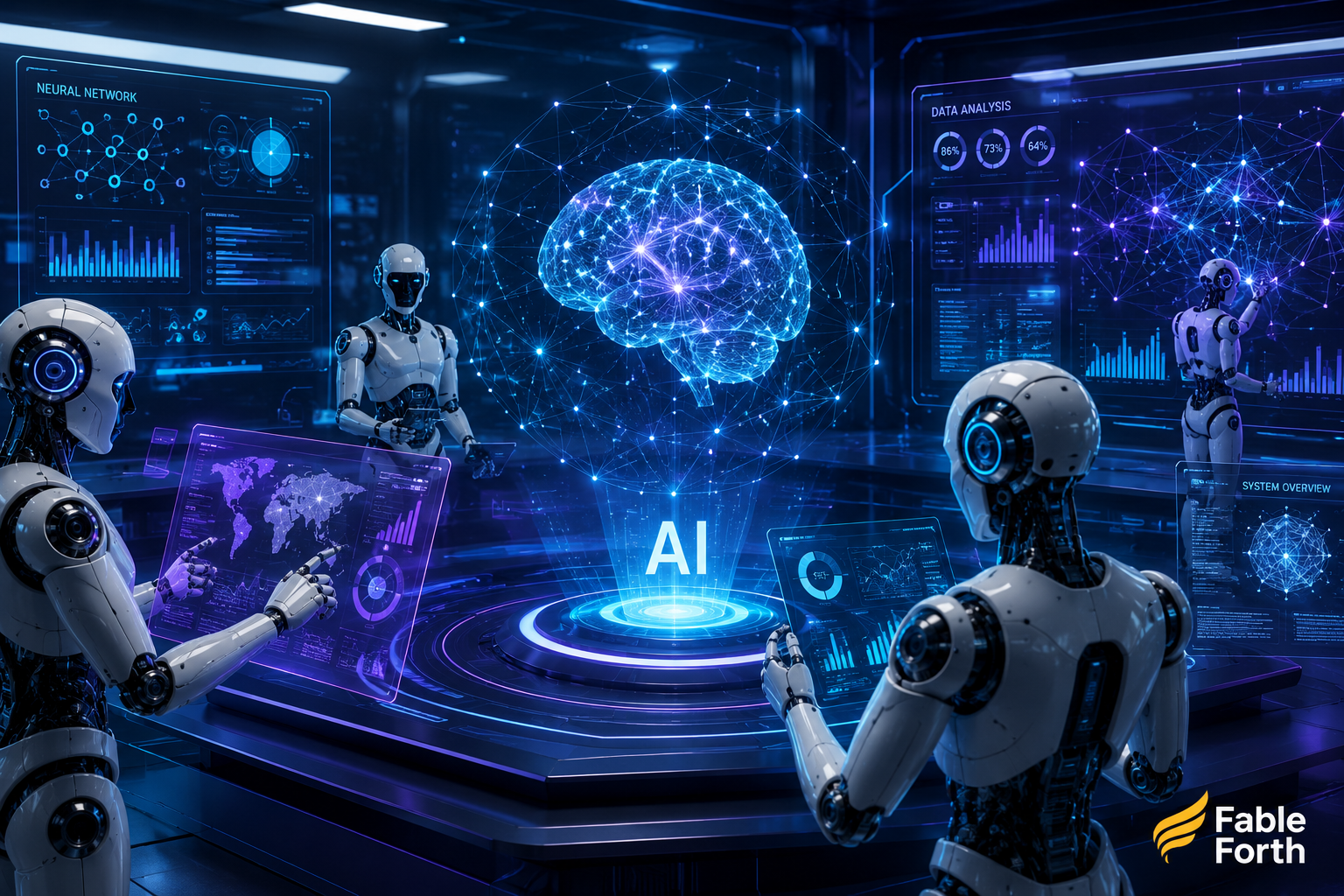
Artificial Intelligence is Entering a New Dimension with a Fully-Functional “World Model.” It is shifting from generating text-based content to a much deeper understanding and interaction with the world.
AI systems that can perceive their environment, act on decisions, remember their history, and adapt to real-time interactions are a significant step forward. AI World Models – that are AI models trained in simulated environments – are quickly becoming a reality, with lingbot-world 2.0 being at the forefront of developments.
A New Generation of Language Models:s While the majority of AI Language Models focus on conversational agents or text generation, lingbot-world 2.0 goes beyond.
Its core focus is on interactive virtual worlds for AI agents where they are able to observe, think, plan, and execute. By building a LingBot within a virtual world, you are able to create an environment that an AI Agent can observe, learn from, and even take action within.
The LingBot can explore a world, experiment, reason, and learn skills in simulation. Whether you’re a developer, data scientist, AI enthusiast,t or an entrepreneur looking to innovate in AI, learning about it will give you a real advantage.
What Is lingbot-world 2.0?
Lingbot-world 2.0 is an AI framework that supports agents to build learning models of environments they inhabit, so the agent learns a richer representation of the world and can learn by reasoning from experiences, rather than solely by being pre-programmed.
The framework includes several key modern AI capabilities,s including language understanding, memory, planning, and environmental perception, all within a single, co-ordinating structure to produce more human-like behaviour in AI agents.
Why Is Lingbot-World 2.0 Important?
AI can’t get a better future if it stays at answering your queries.
Organizations, research centers, and Universities are now actively searching for AI solutions capable of decision-making, cooperating with other AI agents, and improvising based on circumstances.
To address this problem, Lingbot-World 2.0 presents a versatile solution which allows AI agents to:
- Explore virtual spaces
- Understand objects and locations
- Learn from experience
- Plan multiple actions ahead
- Solve complex problems
- Work with other AI agents
Such abilities are helpful both in research and commercial use cases.
Top Features of lingbot-world 2.0
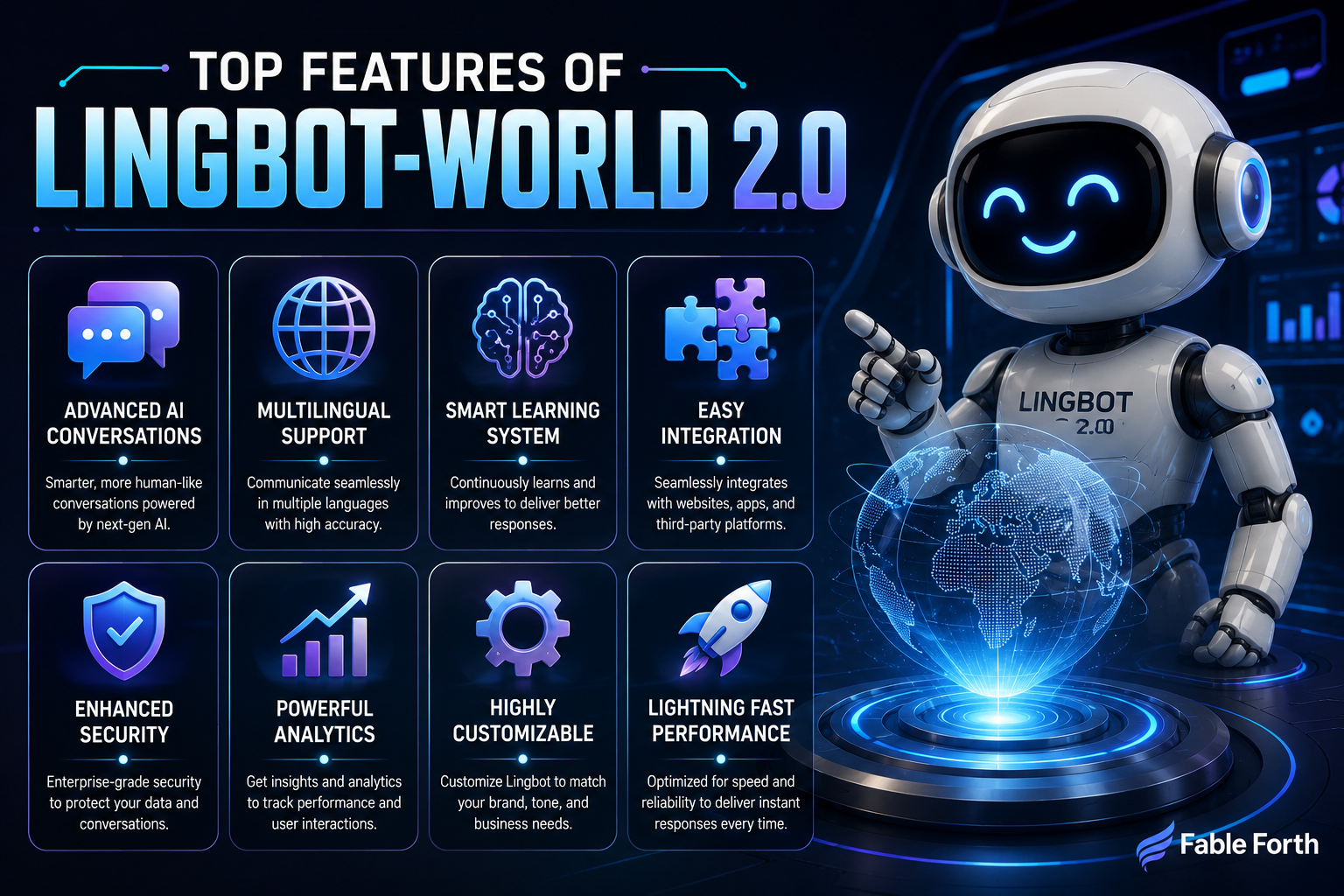
1. Intelligent Environmental Understanding
Another very exciting addition to it is the fact that the world can be interpreted as interactive, instead of just some arbitrary information points.
The AI agents now have awareness of the following:
- Objects
- Locations
- Tasks
- Environmental changes
- Relationships between different elements
And this allows us to be much smarter at decision-making.
2. Enhanced Long-Term Memory
The importance of the agent’s ability to remember past behavior should be obvious for truly intelligent action.
In addition to helping AI agents simply not forget everything it has already learned, it helps AI agents remember helpful experiences and then apply those memories to future problems as well.
Some of the advantages include:
- Better conversations
- Improved reasoning
- Higher consistency
- Faster learning
- More efficient planning
3. Autonomous Task Planning
The ability to plan is one of the signatures of advanced AI. Instead of simply responding to a single command, lingbot-world 2.0 decomposes the overall task into sub-tasks.
For example, an AI agent that has been assigned to organize a warehouse might have figured out the order in which actions should be carried out on its own, without needing explicit commands.
4. Multi-Agent Collaboration
Complex AIs need to cooperate.
Lingbot-world 2.0 allows different AI agents to communicate with each other, share knowledge, and collaboratively work toward achieving common objectives.
Some example use cases are:
- Robotics
- Scientific research
- Smart manufacturing
- Autonomous logistics
- Virtual training simulations
5. Adaptive Learning
Unlike a fixed AI model, lingbot-world 2.0 automatically adjusts to a dynamic environment.
Should something new come up or should objectives be modified during a given mission, AI agents are capable of redefining strategies on the go without needing to completely restart a mission.
This leads to better results in an unforeseen setting.
How Does lingbot-world 2.0 Work?
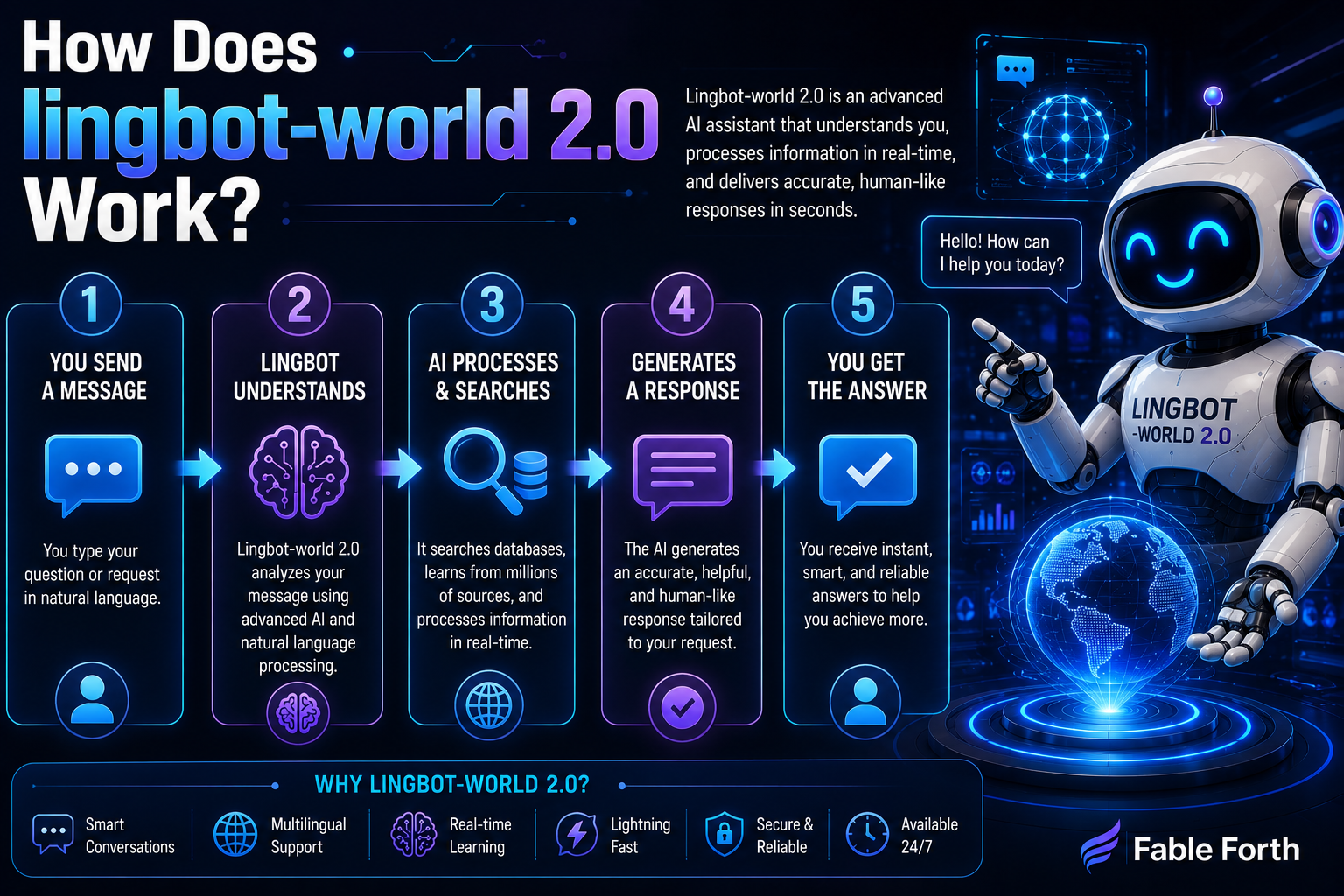
The platform brings together various components of AI to work as one smart system.
Language Understanding
Artificial intelligence systems use language processing to interpret directions, pose inquiries, and correspond effectively.
World Modeling
The AI has a model of its environment in its mind.
This assists the AI in knowing:
- Where objects are located
- Which actions are possible
- How different elements interact
Memory Management
This is the way to have the AI actually get good instead of starting anew every time we interact. If you store experiences that would help you make a decision, you save yourself time.
Decision Engine
The decision engine can test multiple solutions before picking out the ideal one. This leads to smarter, more robust behaviour.
Continuous Learning
As more information is gathered, these AI agents learn about the world and perform more efficiently as time passes.
Real-World Applications of lingbot-world 2.0
The technology of lingbot-world 2.0 can be implemented in several different business applications.
Robotics
These robots may be trained by engineers inside secure simulated worlds before they can be sent out into factories, warehouse buildings, hospitals, or personal residences.
Healthcare Research
We provide realistic medical simulation where our AI agents play a part in workflow planning, in a training environment, and on an operational level.
Education
Universities can use interactive simulations to educate students in machine learning, robotics, and autonomous systems.
Video Games
An opportunity for developers is that they may be capable of creating “intelligent” NPCs, the characters in video games that may recall interactions, change in response to player selections, and work in concert with different NPCs.
Enterprise Automation
With AI agents, business processes may now also reflect complicated workflows through cooperation and allocation of tasks and reacting to different market situations.
Benefits of Using lingbot-world 2.0
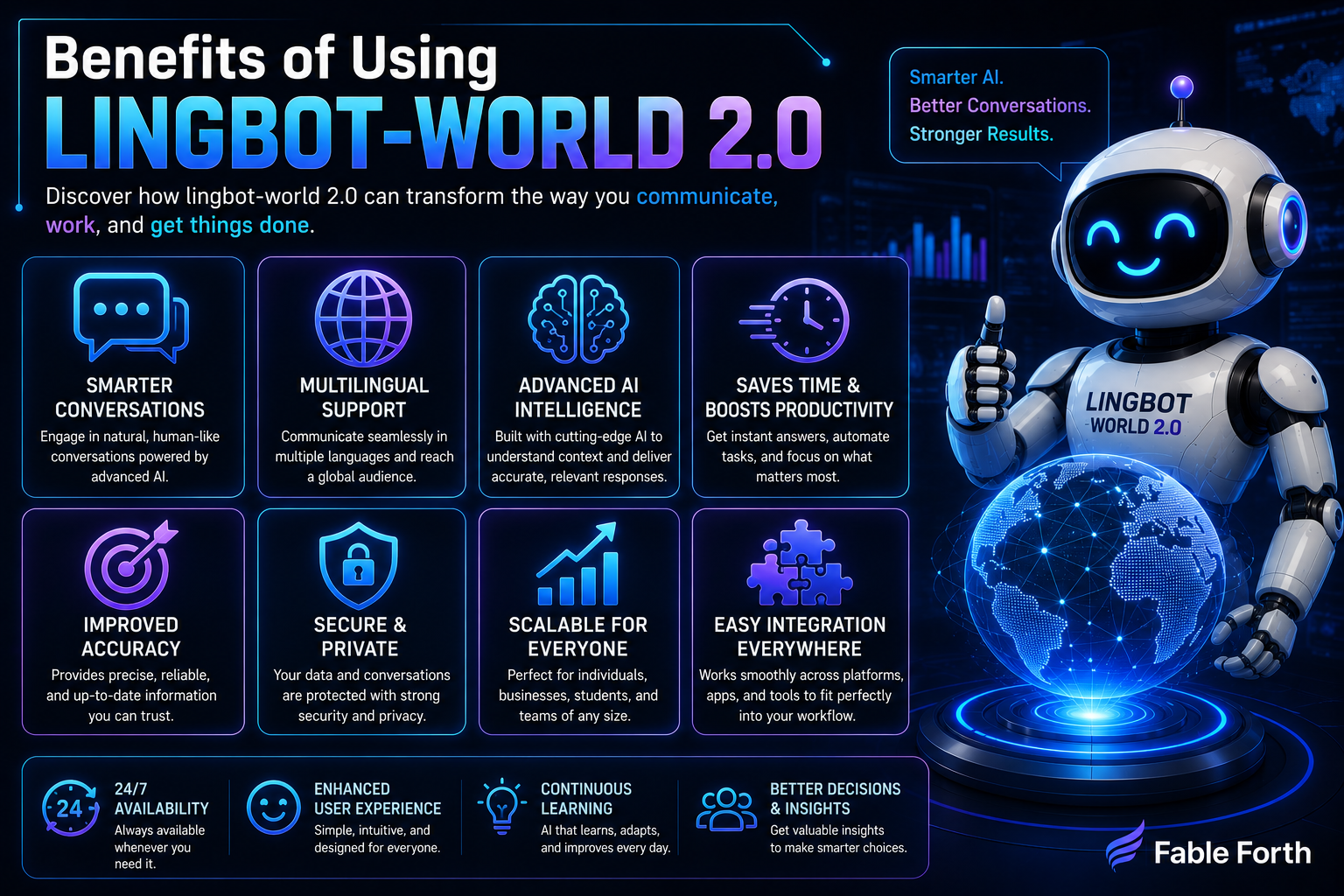
When organizations and developers use bot-world 2.0, they can realize the following benefits:
- Smarter AI behavior
- Improved planning capabilities
- Better memory retention
- Realistic simulation environments
- Faster AI experimentation
- Lower development risks
- Open-source flexibility
- Scalable architecture
- Enhanced collaboration between AI agents
- Future-ready AI development
Why Lingbot-World 2.0 Matters for the Future of AI
AI is evolving from passively waiting for instructions to actively comprehending and navigating complex worlds. It enables just that, allowing agents to watch, infer, act, and adjust. World models like it will be crucial in developing the smart systems that industries will increasingly invest in for an automated future.
Challenges and Limitations of lingbot-world 2.0
However, in lingbot-world 2.0, you are already experiencing many promising improvements to AI world modeling capabilities; you are still just dealing with research at the edge of the state-of-the-art technology, and this leads to limitations, which anyone interested in applying such a system must take into account.
1. Hardware Demands
For running computationally intensive AI simulations, there are high-speed GPUs, lots of RAM, and extremely quick drives needed to do so, although less demanding runs of a simulation can be performed locally using less advanced equipment, and many organizations will need more robust compute infrastructure in order to create and execute large-scale environments.
2. Learning Curve
If it is the first time you will experience an AI world model, it will take time for you to get along with ideas like simulation of environments, planning of agents, reinforcement learning, memory module, and so on.
3. Simulation Accuracy
However, virtual training can’t account for the intricacies of the physical world. AI models solely trained within virtual training settings still need further tests before real-world deployment.
4. Ongoing Development
Since it is still under active development, the docs, features, and api can change in the future. Follow along for more updates!
lingbot-world 2.0 vs Traditional AI Models
This lingbot-world 2.0 model often comes into comparison with traditional large language models. Even though they both function as a result of machine learning, their design intentions and features are entirely different.
| Feature | lingbot-world 2.0 | Traditional AI Models |
| Understands Virtual Environments | ✔ Yes | ❌ No |
| Long-Term Memory | ✔ Advanced | Limited |
| Multi-Agent Collaboration | ✔ Supported | Rare |
| Action Planning | ✔ Multi-Step | Mostly Prompt-Based |
| Real-Time Environment Interaction | ✔ Yes | No |
| Autonomous Decision Making | ✔ Strong | Moderate |
| Research Applications | Excellent | Good |
| Simulation Training | ✔ Built-In | Not Designed For It |
This time, instead of generating text, AI (lingbot-world 2.0) is observing the world, thinking, and taking actions in it.
lingbot-world Roadmap to lingbot-world 2.0
This is a plan for what they’re going to construct to help build out Lingbot-world 2.0 as they focus on developing higher and higher levels of reasoning and an ability for AI to act autonomously, over the next year or so.
Below are expected improvements:
Better Robotics Integration
This could eventually interface virtual training with physical robots for faster development time and improved real-world outcomes.
Richer Virtual Worlds
AI agents would be able to accomplish increasingly challenging missions with larger and more intricate simulation settings.
Faster Learning Algorithms
Developers are exploring ways to optimize AI efficiency, allowing intelligent agents to acquire expertise through fewer interactions.
Improved Teamwork
When two or more artificial agents communicate with each other better, they can come together to solve problems in manufacturing, research, and logistics.
Enterprise AI Solutions
We can imagine this as a solution for deployment in future organizations where workflows or their digital twins (or even a simulation of operations) can be intelligently augmented.
Tips and Tricks to Making Lingbot-world 2.0 Work Like Magic
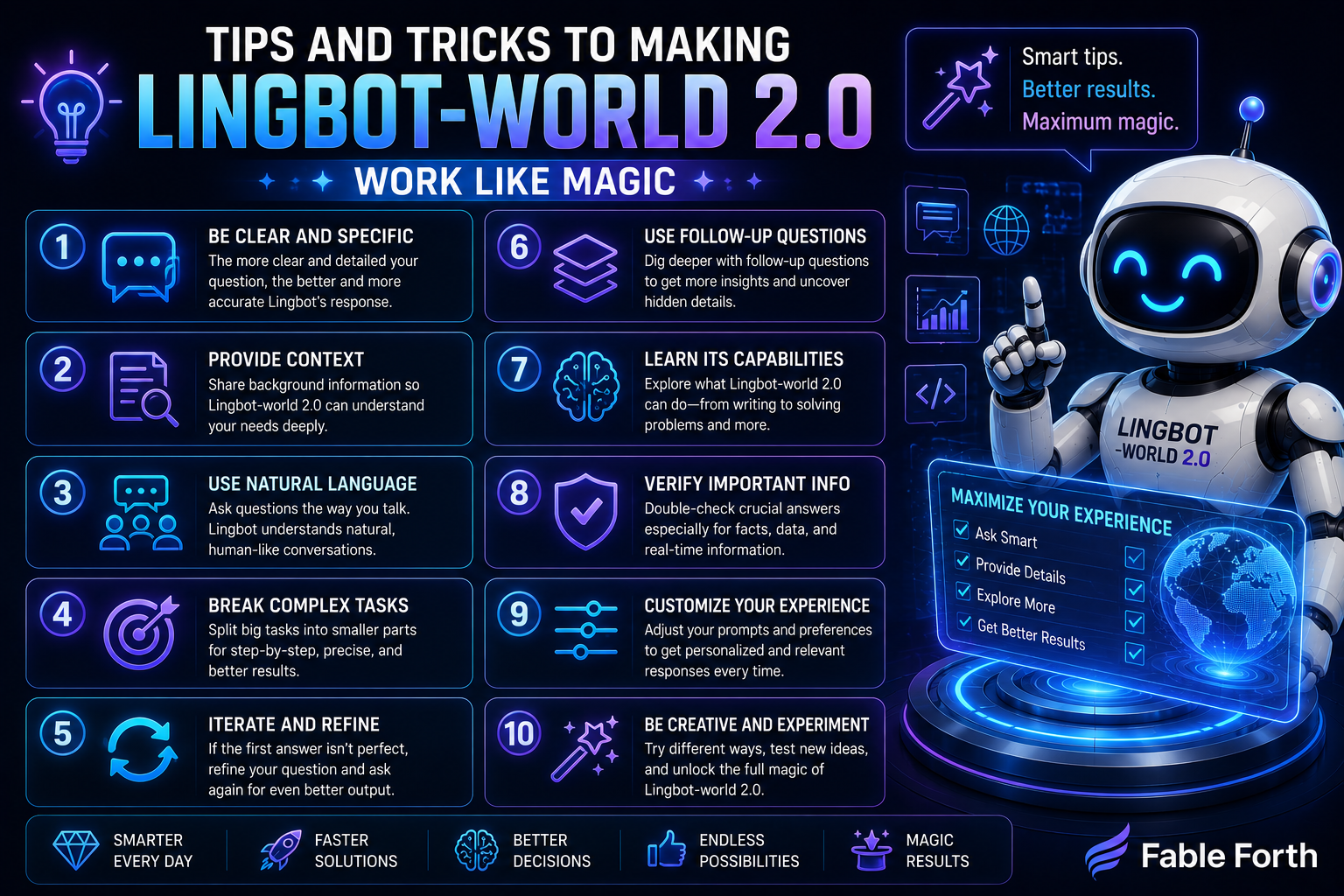
Here are some tips on where to look if you’d like to investigate lingbot-world 2.0:
- Master the basics of Python and machine learning.
- Study planning and reinforcement learning for AI.
- Start with small simulation problems first, and later build on more challenging environments.
- Read the official documentation and research papers.
- Participate in the open-source community and get insights from developers.
- Deploy your AI agents into multiple settings and gauge their performance.
- Keep yourself informed when there is an upgrade.
Who can use lingbot-world 2.0?
The platform will also be of value for anyone:
AI Researchers
Create novel algorithms and perform tests of intelligent agents under controlled environments.
Robotics Engineers
Simulate robots in a virtual environment before testing them in real-world circumstances.
Universities
Simulation platforms and real-time environments that educators can leverage to teach complex AI concepts.
Game Developers
Bring non-player characters to life, giving them intelligent, evolving behaviors.
Technology Companies
Develop proof of concept for a range of autonomous systems; digital assistants and workflows.
Some Frequently Asked Questions
The purpose of lingbot-world 2.0
The main use cases of LingBot-World 2.0 are to construct and validate agents that can communicate with a virtual world and decide on how to take multi-agent or single-agent actions to achieve a complex objective through several steps.
Is LingBot-World 2.0 free?
It’s set up as an open-source research platform, so anyone looking to experiment with more sophisticated AI world models can use the code to do it.
Is lingbot-world 2.0 suitable for beginners?
Yes, but beginners ought to be aware of some of the basic programming principles, some basic machine learning, and basic artificial intelligence before proceeding to advanced world models.
How is lingbot-world 2.0 different from ChatGPT?
Where ChatGPT deals with text output, AI, humans, and answering questions, the lingbot-world 2.0 environment can simulate situations in which AI agents might see, plan, recall, or do things in an attempt to achieve objectives.
Can businesses use lingbot-world 2.0?
Yes. Robotics automation research education gaming enterprise AI organizations could test drive for their simulation testing, etc etc.
Final Thoughts
AI has moved beyond language models, and lingbot-world 2.0 showcases this shift.
Integrated with interactive simulations, persistent memory, robust planning capabilities, and cooperating agents, it takes AI into a new frontier toward fully automated and adaptive agents.
Even though the product is a beta product, its design and open-source nature make it ideal for developers, businesses, and educators eager to see how AI is taking form.
World models continue to advance, and it’s certain to have a prominent role in areas like enterprise robotics, robotics for enterprise automation, educational platforms, gaming platforms, and more.
If your goal is to better understand where AI is heading, knowing about Lingbot-World 2.0 now can definitely make you a part of the revolution.
